arrow-down arrow-left arrow-nav arrow-right arrow-up close db-alumni db-current db-faculty db-fmaily db-future db-online download facebook gallery help linked-in maximize menu minimize pause play print search share twitter youtube zinfolio

Where Performance Meets Principle: Inside Life University’s New Sports Chiropractic Track

At the intersection of high-level athletic performance and principled chiropractic care, a new educational pathway is taking shape at Life University (Life U).

Life University’s flagship Doctor of Chiropractic (D.C.) program will introduce a dedicated Sports Chiropractic track beginning Fall Quarter 2026 – an intentionally designed, performance-first experience built to prepare future chiropractors for the realities of modern sport. This new track is not an add-on or a specialization tacked on at the end of the program. Instead, it is fully integrated into the D.C. curriculum, blending classroom learning, clinical application, sport science, and real-world athlete exposure.

For students passionate about performance, movement and whole-person care, the Sports Chiropractic track represents something different – and something needed.

More Than Rehab: A Performance-First Philosophy

In many settings, sports-related care remains reactive, focusing primarily on injury management and rehabilitation. Life U’s Sports Chiropractic track was built with a different mindset.

Here, chiropractic care is approached through the lens of performance optimization. Students learn to evaluate how the nervous system, joint mechanics and movement patterns influence efficiency, adaptability and readiness – long before injury occurs. This neurology-driven, global mechanical assessment philosophy aligns naturally with sport, where milliseconds, positioning and coordination can make the difference between winning and falling behind.

The result is an educational experience rooted in chiropractic principles while fully attuned to the demands of athletics.

A Campus That Functions as a Living Lab
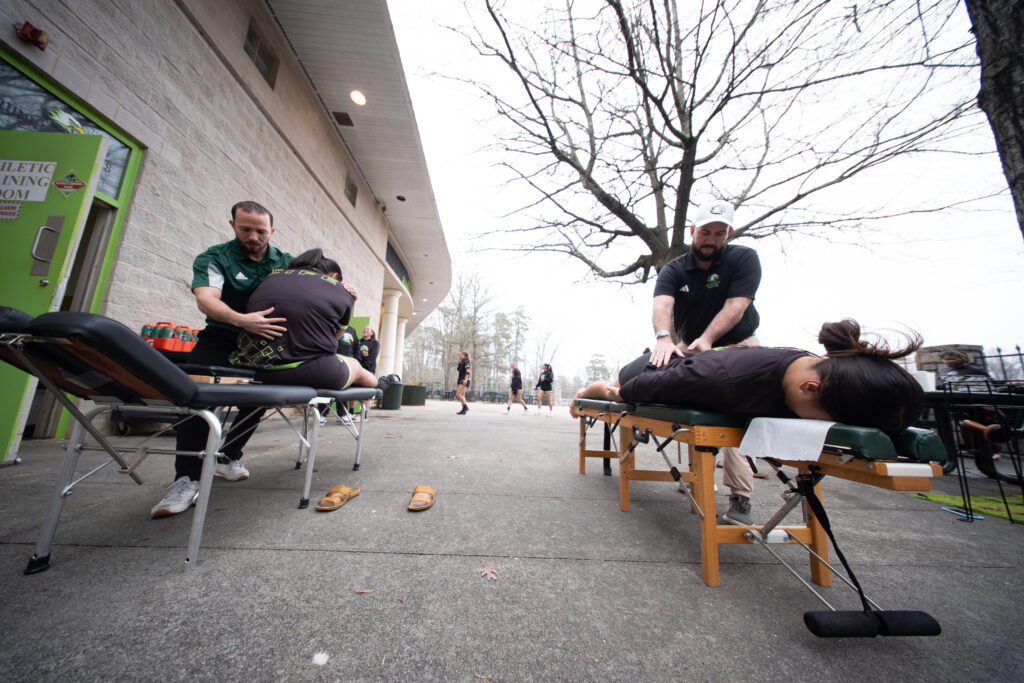
20260228 Life SB12717

Life U’s campus ecosystem is a defining feature of the track.

With more than 650 varsity student-athletes competing across 21 sports teams, Life U offers an environment that few institutions – chiropractic or otherwise – can replicate. For Sports Chiropractic students, these athletes are not theoretical case studies. They are active participants in the learning process.

Students gain hands-on experience with performance testing, movement analysis and on-venue observation, all while collaborating with athletic trainers, strength and conditioning coaches, and sports health professionals. Real data, real athletes and real performance settings transform the campus into a living lab for human performance.

How the Sports Chiropractic Track Works

The Sports Chiropractic track unfolds intentionally within the D.C. program:

  • Quarter 8 introduces students to sports chiropractic concepts and expectations, laying the groundwork for applied learning.
  • Quarters 9–12 deliver a four-course Sports Chiropractic sequence that includes performance testing labs, arthrokinematics and neurology, on-venue and sideline care, and a research-based sports practicum.
  • Quarters 13–14 place students in sports-focused PEAK and community-based internships, allowing them to apply their skills in professional, real-world environments.

Rather than waiting until after graduation to engage with sport, students progress through increasing levels of responsibility and exposure throughout their education.

Integrated Learning Across Disciplines

Sports Chiropractic rarely exists in isolation – and neither does Life University’s approach.

Students in the track learn to function as part of a broader performance team, interpreting athlete data, understanding injury risk profiles and contributing to clear, coach-ready and athlete-ready communication. This integrated model mirrors what graduates will experience in performance clinics, collegiate athletics and professional sport environments.

By learning how Chiropractic fits within a multidisciplinary performance strategy, students graduate prepared not only to deliver care but to collaborate effectively.

An Accelerated Academic Opportunity

For students interested in deepening their expertise, the track offers an additional advantage.

Those who complete the Sports Chiropractic coursework can apply those credits toward the Master of Science in Sport Health Science (Sports Chiropractic concentration). With the addition of two Professional Track courses, students can complete nearly half of the master’s degree while earning their Doctor of Chiropractic.

This accelerated pathway allows students to broaden their credentials without extending their overall time in school.

Preparing Graduates for Performance Environments

Graduates of the Sports Chiropractic track pursue diverse roles, including:

  • Team chiropractor
  • Integrated sports-rehab clinician
  • Performance clinic owner
  • Consultant for sport organizations
  • Researcher or educator in sports performance

No matter the setting, the throughline is the same: chiropractors prepared to think critically, act confidently and contribute meaningfully in performance-driven environments.

Efficiency. Performance. Purpose.

Michael Hartfield

As Olympian and Life University D.C. alumnus Michael Hartfield, D.C. (’26), puts it:

“Effort won’t ever beat efficiency – and Chiropractic gave me efficiency.”

That idea lies at the heart of Life University’s Sports Chiropractic track – an educational experience where performance meets principle – and where future chiropractors are prepared not only to support athletes, but also to help them perform at their highest, most optimal level.


Staying on Track: Track & Field, Physical Therapy Career Goals and more with Brianna Florvilus- Podcast

[vc_video link=”https://www.youtube.com/watch?v=k3BslmHnksI” align=”center”][vc_separator]Brianna Florvilus is always on the move. As an M.S. in Sport Health Science student and a member of the Life U Women’s Track and Field team, Florvilus is working hard to make her career goals to become a physical therapist a reality. She discusses her interest in Injury prevention and the aspects of the physical therapy profession that she enjoys in this podcast.

Volleying into Improved Health with Tennis

Getting enough exercise can be a real drag, especially if you are mentally tired from a long day at school or work. That’s why so many people turn to sports to turn movement into a game, making exercise fun and competitive if necessary. There are plenty of sports to choose from, but today we will focus on the health benefits of one of the world’s oldest sports: tennis. Healthline goes into more detail about tennis as fitness in their article “Is Tennis Good Exercise? All You Need to Know.”

Tennis as a Workout 

Most of the physical benefits of tennis are related to working the cardiovascular system, as you increase your heart rate and breathing as you play. It also incorporates large lower body muscles during fast side-to-side and front-to-back moves, as well as the upper body muscles involved in swinging the racket.

So, depending on the intensity at which a player participates, tennis can be a total-body workout for cardiovascular fitness as well as a workout for better muscle endurance and strength. It can be a major calorie burner as well. The CDC classifies singles (one-on-one) tennis as a vigorous-intensity activity. Generally speaking, a 154-pound person should burn 220-295 calories engaged in 30 minutes of vigorous activity, according to the CDC.

People playing for general fitness play on average 60 to 90 minutes, but players of competitive tennis can play matches that range from 90 minutes to almost 3 hours. Either way, it’s a great way to burn calories, be social and get some fresh air (if playing outdoors). Combined with a healthy diet, tennis and other dedicated exercises can support weight loss as well.

Other Health Benefits of Tennis

If you want a killer cardiovascular exercise that makes muscles stronger and improves endurance, balance, coordination and agility, tennis is a good option. As a sport that requires a partner to be fully played, it also can help to increase social interaction and a sense of community. As you continue to play with friends and acquaintances over a longer period of time, physical stamina grows along with your social well-being.

Tennis is a lifetime sport that you can adapt to whatever stage of life you are in, especially since it is low-contact. Therefore, the risk of injury is lower than contact-heavy sports like basketball and soccer.

It’s good for the health of your heart as well. A scholarly article for the American Journal of Sports Medicine detailed a study that found that people who play racket sports had a 59% reduction in cardiovascular disease-related mortality, as well as a 47% reduction in mortality of all health causes.

If you feel you need better balance, coordination and posture, tennis can also help you work on that. Tennis uses a lot of lateral movement, as well as forward and backward footwork, yet the side-to-side movement is what most challenges balance and coordination. Direction changes needed to chase a ball also improve muscle function and balance.

Getting the most out of your tennis workout

  • Lessons in a group or private setting can be helpful to learn the right techniques.
  • Play with opponents of all skill levels, switching it up to challenge yourself as well as giving others a chance to learn the game with you.
  • Remember to warm up so you will play well and avoid injury. Dynamic warmups before playing are recommended. Utilize static stretches for after-match recovery.
  • Make a point to use proper form, as it will improve your skills and help reduce the chance of injury.
  • Keep your eye on the ball and stay alert. Try to keep moving as much as you can.
  • Play alone or with a friend. When alone, hit against a wall or use an automatic tennis ball launcher.
  • Try out different surfaces. Some surfaces are more forgiving on the joints than others. The three main types are grass, clay and hard court (often concrete).
  • Strength training can also help improve your health and your game.

M.S. Sport Health Science- Tennis Fitness & Sport Science Track at Life University (Life U)

For those with a more advanced commitment to the sport, Life U’s Master of Science Sport Health Science- Tennis Fitness & Sport Science Track is a unique opportunity to turn that passion into a viable career path. Learn more at life.edu.

LIFE University Track and Field Athlete Breaks National Record

[vc_single_image image=”18900″ img_size=”full” alignment=”center”]

Iowa City, Iowa- January 26, 2023 – Life University (Life U) is proud to have many world-class athletes on their roster and to celebrate their victories, such as C.J Allen’s recent setting of a new American record at the American Track League Pro Puma Classic meet held at the University of Iowa this past Friday and Saturday, January 20-21, 2023.

This is a picture of Life U student and graduate assistant C.J. Allen, who set a U.S. record at the American Track League Pro Puma Classic meet held January 20-21, 2023.
Life U student and graduate assistant C.J. Allen, who set a U.S. record at the American Track League Pro Puma Classic meet held January 20-21, 2023.

Allen is a 12th-quarter Doctor of Chiropractic student who is also working on his Master’s in Sport Health Science in Life U’s Sports Chiropractic track. Additionally, he is a graduate assistant for Life U’s Men’s Track and Field team.

Allen has said “it feels indescribable” as he recounts the journey to his setting a new National 400-meter hurdle indoor record, which was only .10 seconds short of the world record. The team also ran a 4×400 meter relay facility record after the hurdles race.

“I have been working so incredibly hard for so many years that when it happened it just felt right. I was asked a couple weeks ago to come to Iowa for the American Track League Pro Puma Classic meet, so it wasn’t a lot of time for some minor tune-up work before the race,” said Allen. “A season opener and American record in one is an exciting start to the season. I know, here at Life U, we plan to repeat as national champs, and I can’t wait to be alongside the coaching staff to guide our team to that victory again.”

This picture shows Life U student and graduate assistant C.J. Allen hurdling over a hurdle during his U.S. record run.Allen has inspiring future plans in the sport, hoping to continue to improve and push himself to his best potential.

“As for the future for me, I have plans to make the U.S. World Championship and Olympic team,” said Allen.

Founded in 1974, Life University is a health sciences institution most known for its College of Chiropractic, the largest single-campus College of Chiropractic in the world. Undergraduates can pursue undergraduate degrees; a pre-chiropractic, degree-seeking pathway; and graduate degrees within the College of Graduate and Undergraduate Studies. Some degree programs are offered to distance learners through the College of Online Education.

Life University strives to empower our students to succeed both professionally and personally. At Life U, we innovate our approach to higher education, while also remaining true to our philosophical commitment to produce informed leaders who exemplify humanistic values in their professions. To achieve this goal, Life U recognizes and demonstrates its dedication through three official Life University Values: Lasting Purpose, Vitalism and Integrity.

Life U’s 110-acre campus in Marietta, Georgia, just northwest of Atlanta, is home to more than 2,700 undergraduate, graduate and professional students who come from all 50 United States and more than 65 countries.

For more information about Life University, visit life.edu.

About Life University

Life University is regionally accredited by the Southern Association of Colleges and Schools Commission on Colleges (SACSCOC) to award associate, baccalaureate, master’s and Doctor of Chiropractic degrees, and also has programmatic accreditation through the Council on Chiropractic Education (CCE) and the Accreditation Council for Education in Nutrition and Dietetics (ACEND). The mission of Life University is to empower students with the education, skills and values necessary for career success and life fulfillment, based on a vitalistic philosophy.