arrow-down arrow-left arrow-nav arrow-right arrow-up close db-alumni db-current db-faculty db-fmaily db-future db-online download facebook gallery help linked-in maximize menu minimize pause play print search share twitter youtube zinfolio

Dr. Richard Belcastro, Dean, College of Online Education (COE) at Life University

Dr. Richard Belcastro, Dean, College of Online Education (COE) at Life University

Dr. Richard Belcastro has been the Dean of the College of Online Education (COE) at Life University (Life U) for a little more than five years. He was drawn to Life U because of the opportunity to begin building an online school from the ground up. Dr. Belcastro has a Bachelor’s Degree in Education with a specialization in Special Education, a Master’s Degree in Education Administration and a Doctorate Degree in Special Education with a minor in Education Administration, all from West Virginia University.

“When I saw the position at Life U, it gave me the opportunity to start from scratch and build something that, in my opinion, would be special,” said Dr. Belcastro. “Judging from my experience in my previous position, I knew how to be effective and increase student success, and I wanted to bring that to a whole new group of students. Life U presented a unique opportunity. The College of Online [Education] wasn’t even here when I came on. It was just online programs. I wanted to be able to start from that, build that foundation and begin building on it at a new institution that hadn’t experienced it before, which was Life U.”

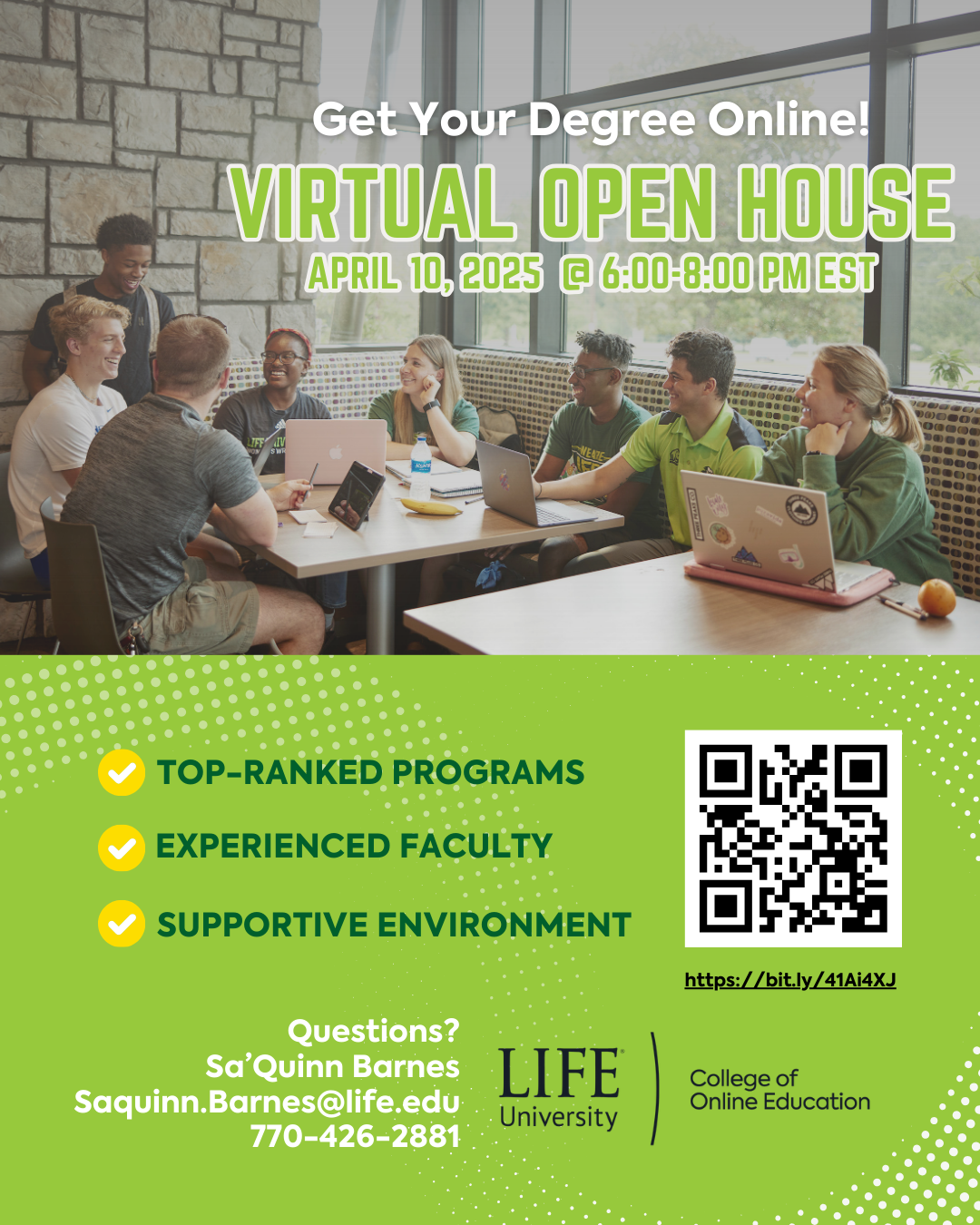
The College of Online Education was created at Life U in order to be competitive and offer similar programs to other higher education institutions. An online education at Life U is different from other institutions because the classes are not held in real-time, meaning students can take courses at their own convenience, which helps with scheduling conflicts.

There are project and course deadlines set that must be met, but a student does not need to sign on at a specific time. Instead, the student is allowed to weave courses into their schedule on their own time, giving them asynchronous studies that make life more flexible. Main campus students are also able to take online classes, and they do, often from the comfort of their home, dorm, the Library or even a nearby café. Students can also live in another state and still receive an education and a Life U diploma, saving travel and moving expenses.

According to Dr. Belcastro, there are several reasons why Life U’s COE is different from other universities. To begin with, he pointed out that our full-time online faculty are not only experts in their field, but also very knowledgeable in online education. Dr. Belcastro noted that the faculty are very accommodating and work hard to ensure that students are successful. Faculty have a high “touch rate,” reaching out to all of their students in the first week of classes.

“Our faculty go the extra mile to make sure students feel comfortable with not only the material that is in the class, but also with the online format,” said Dr. Belcastro.

Another major difference is that Vitalism is integrated throughout the online curriculum, and starting 2022 Fall Quarter, there will be a new course devoted specifically to Physiology and Vitalism.

Dr. Belcastro is proud of the online course design. Life U does not purchase prepacked courses; instead, all of the courses are designed by people who work for the University. This ensures both academic integrity and comprehensive flow for each course. The University is also hiring a media producer to help create a more engaging experience for students tailored to their specific curriculum. The COE is continually looking toward these and other enhancements in order to meet the main goal of preparing students for their next steps, whether that means entering the job market, furthering their career or continuing on to the next level of their education.

The College of Online Education’s B.S. in Biology was ranked among the “15 Best Biology Online” in 2021 by the Bachelor’s Degree Center, and “Life U’s Online Master’s in Psychology Program has been ranked No. 3 for Best Online Master’s in Psychology Programs and was awarded the title of “Best for International Students” according to Intelligent.com.

“Life U’s online education is committed to you as a student being successful. I can’t emphasize that enough,” remarked Dr. Belcastro on what he would say specifically to prospective students who may be considering an online education at Life U. “We are deeply committed to students’ success. A student’s educational journey here at Life U is one that they do not embark on alone; it is one that is a partnership with us. We are there every step of the way providing support. It’s one thing to have a fantastic curriculum, instructors, courses and programs, which we do, but it’s another thing to recognize, even with all of that, students still need help sometimes, and we are here for them to help them accomplish that. If the student is not successful, we’re not successful. If you are a student considering Life U online, I am going to tell you that we are going to do everything possible within the relm of academic integrity and rigor to ensure that you are successful.”


Slice of LIFE is an invitation to and extension of everything happening at Life U. Whether you are a current student, a potential freshman or a proud alumni, Slice of LIFE can help keep you connected to your academic community. Know of a compelling Life U story to be shared, such as a riveting project, innovative group or something similar? Let us know by emailing Marketing@life.edu.

Coaching Psychology: What is it and why is it important?

Coaching Psychology: What is it and why is it important?

Life University (Life U) offers a Master of Science (M.S.) degree program in Positive Psychology with two tracks: General Positive Psychology and Coaching Psychology. This online degree program is fully accredited and one-of-a-kind. In fact, it is one of only a handful of such highly sought-after programs in the entire world. The M.S. in Positive Psychology at Life University investigates strengths-based research that enables individuals and communities to thrive. It is focused on the study of flourishing and positive human functioning, in particular key areas such as meaning in life and cultivating what is best within themselves.

In particular, the Coaching Psychology track has gained a fair amount of traction and interest in recent years. Coaching in this context refers to training in executive and life coaching through a positive psychology lens and a focus on mindfulness. Prior to the introduction of the M.S in Positive Psychology at Life U in 2014, there was a bachelor ‘s program available. But instructors noted interest in Positive Psychology and the coaching track proved greater with students further in their careers or often looking for a career change. Thus, the program was converted to a graduate degree.

“With the commitment and ongoing support of this admirable team of instructors at Life University, my eyes were opened to the world of positive psychology coaching, and I have confidently launched the personal development business of my dreams. I am quite proud, honored and grateful to say that I earned my graduate degree from this fine institution and will continue to live in abundance with Lasting Purpose,” said Jonathan Powell in a student testimonial. Powell is a M.S in Positive Psychology- Coaching Track alumnus and CEO of Monumental Paths, working as a Positive Psychology Coach and Educator.

In the creation of the curriculum and teaching methods for this cutting-edge field of study at Life U, a fair amount of thought went into implementing best practices at that time for teaching coaching psychology, backed up by research largely provided by Anthony Grant, Professor of Coaching Psychology at the University of Sydney.

“One of the key components we were looking at was theoretical basis, evidence-based psychology versus just a model. [We didn’t want to just say] ‘Here’s a model; go use it for your coaching.’ We wanted our students to truly understand learning theory—psychological theory—so it makes them more agile and more confident practitioners of coaching and positive psychology in general,” said Assistant Professor of M.S. Positive and Coaching Psychology Dr. Mickey Parsons.

In a recent class lecture, Dr. Parsons presented helpful background information that illuminates the growth potential of this burgeoning field.

“In 1995, Thomas Leonard started the International Coach Federation (ICF) as a nonprofit organization for the coaching community, and today, there are more than 50,000 members of ICF across 140 countries certified coaches,” noted Dr. Parsons in his recent lecture. “The profession of coaching continues to grow, and with that growth, new distinctions continue to surface. The term evidence-based coaching was introduced in 2003 to demonstrate how professional coaching is anchored in empirical and theoretical knowledge (such as positive psychology, cognitive behavioral theory and the like) versus what others may describe as loosely constructed trends in pop psychology.”

“At Life U, we take a positive psychology approach to coaching,” explained Dr. Parsons. “In fact, coaching psychology is a subset of the positive psychology umbrella, providing a theoretical framework and science for coaching practice. This theoretical cornerstone combined with the ICF core coaching competencies equips our students with knowledge and skills to be agile, evidence-based coaches capable of helping clients manage change, grow and thrive. Positive Psychology, in short, is the scientific study of what makes life most worth living. By cultivating positive emotion, experiences, meaning and relationships in our lives, we naturally enhance our wellbeing and that of our clients, client companies and beyond.”

At the completion of an M.S in Positive Psychology- Coaching Track, a student will be prepared to sit for either an Associate Certified Coaching Certification or a Professional Certified Coaching Certification through ICF, based on student goals as well as accumulated training and coaching hours.

“Through the years, coaching has become much more popular and now recognized by a lot of major institutions. But most institutions when they reach out to coaches, they do want them to be certified by ICF,” said Dr. Richard Shook, Assistant Professor of Psychology at Life U.

By their second quarter, students in this program are encouraged to begin building a clientele of sorts and practice peer coaching with one another to build upon skills and techniques. Professors connected to this program also offer mentorship and supervision as appropriate and encourage students to utilize external resources as much as possible.

It’s a profession in constant flux, so students are lucky to have professors with practical, current knowledge of the industry, as many of the professors of the program also have successful practices outside of Life U. Dr. Parsons, for example, is the Founder of The Workplace Coach, an executive coaching company that has been in business for more than 23 years and that “provides strategy, structure and solutions that equip leaders and their organizations for innovative results.”

“I think that the practitioner model gives students great insights into what’s going on inside the profession,” said Dr. Parsons. “We are not just talking theory; we are talking first-hand experience. We discuss how to do contracting, what are issues that come up with clients and with corporate clients. What are the ethics of day-to-day coaching practice?”

It’s exciting to see Life U students eagerly enter this emergent field and create success for themselves and their clients. For more information on the M.S in Positive Psychology- Coaching track, please visit life.edu/academic-pages/college-of-graduate-and-undergraduate-studies/positive-psychology-ms/.


Slice of LIFE is an invitation to and extension of everything happening at Life U. Whether you are a current student, a potential freshman or a proud alumni, Slice of LIFE can help keep you connected to your academic community. Know of a compelling Life U story to be shared, such as a riveting project, innovative group or something similar? Let us know by emailing Marketing@life.edu.
#TBT – Life U on Atlanta & Company: Psychology (2016)

[vc_video link=”https://youtu.be/WlsJOBmbyBI”]Michael Karlin, Ph.D., Assistant Professor of Psychology and Associate Director of the Center for Compassion, Integrity and Secular Ethics at Life University, spoke with Christine Pullara about Life U’s innovative psychology degrees and initiatives. They discuss undergraduate and graduate degree options in Psychology, Business and Positive Psychology.

They also discuss Life University’s collaboration with Etsy.org, as well as The Chillon Project, Life University’s degree-granting program in Georgia’s prison system.

Learn more about Life University’s degrees and programs at: LIFE.edu/Academics.

Learn more about Life University’s Center for Compassion, Integrity and Secular Ethics (CCISE), including The Chillon Project and its collaboration with Etsy.org at: Compassion.LIFE.edu.

Interested in listening to the CCISE’s free Compassion Integrity Training podcasts? Visit: Compassion.LIFE.edu/CIT.

Exploring Biopsychology

As someone who got degrees in English and philosophy, I have always been a little envious of students’ whose majors sounded inherently more impressive. Being able to say “I study quantum physics” or “organic chemistry” always seemed to garner a more impressed reaction than when I told people I had been reading Faulker or Spinoza. Today we are going to take a look at a field of study here at Life University with a similarly impressive moniker and see what is going on behind the title of “biopsychology.”

So, let’s start with the term “psychology” and use that as familiar ground from which we can advance. We are all probably familiar with psychology as the study of our brain’s functions as it relates to the behaviors and attitudes we express. Think of a counseling session as the meeting point between, on one hand, the field of psychology as a complete understanding of how our minds operate and, on the other, the individual sitting in front of the counsellor with their personal needs and desires. This means that for the field of psychology to operate at its best, we need researchers doing the hard work of testing theorems and observing results in a lab, as well as a group who can excel at the bedside manner required for effective face-to-face counseling.

With this in mind, let’s return to that term “biopsychology.” A biopsychologist will be almost entirely interested in the knowledge-building side of the equation and will (in all likelihood) leave the patient-oriented efforts to other professionals. Here the “bio” prefix means that biopsychologists are specifically interested in thinking about how the chemical mechanics within our brain are directly correlated to our feelings and behaviors. What is happening in my brain when a smell powerfully evokes a memory? How about what is happening at the material level of neurons when I forget something? Well, we need professionals who are both deeply trained in both the biological mechanics of the brain as well as the foundations of psychological and behavioral study in order to approach these questions scientifically. That isn’t even to mention the fact that looking so closely at where the immaterial (our thoughts and memories) and the material (the grey matter actually in our head) is drilling into one of the deepest philosophical questions of “what we are” that has been pondered by folks from Plato to Hume to Pinker.

Taking a look at the course offerings that make up a biopsychologist’s curriculum only underlines the intensity of training needed for this profession. While there are only two courses technically labelled “biochemistry,” the rest of the courses that a student may follow are uniquely flexible to their interests.

Just as Chiropractic views the body as a whole, interconnected system, biopsychology tries to zoom the microscope in as close as possible to the link between the chemicals in our brain and our mental experience of the world. On one hand it’s easy to say “Duh, we should be studying the brain if we want to help people deal with mental health,” but the more you look at it, the more you realize how demanding it becomes to train someone who can help put the pieces together all the way from the observatory lab, to the academic conference, to that long couch you lay on while you talk about your dreams. So, when you hear someone tell you they are focusing on biopsychology, your reflex to be impressed is probably the right one.

Learn more about LIFE’s Bachelor of Science in Biopsychology here: https://www.life.edu/academic-pages/college-of-graduate-and-undergraduate-studies/biopsychology-bs/


Slice of LIFE is an invitation to and extension of everything happening at Life University. Whether you are a current student, a potential freshman or a proud alum, Slice of LIFE can help keep you connected to your academic community. Know of a compelling Life U story to be shared, such as a riveting project, innovative group or something similar? Let us know by emailing Marketing@life.edu.