arrow-down arrow-left arrow-nav arrow-right arrow-up close db-alumni db-current db-faculty db-fmaily db-future db-online download facebook gallery help linked-in maximize menu minimize pause play print search share twitter youtube zinfolio

AI Impact for Those New to the Workforce

It’s impossible to tune out the incessant alarmist hysteria related to AI. There is a palpable fear for many that advanced AI tools are poised and ready to allow all the robots to steal all human jobs and throw society in disarray. The truth is more complicated but hopefully a tad more comforting. All major technological change comes with growing pains, and some sectors will feel that strain more than others. Therefore, it is important for college students entering the workforce to be prepared to adapt to AI as it applies to their expected workloads.

Remember when LED light bulbs were popularized? These more efficient marvels of technology deeply disrupted the lighting industry, requiring businesses to quickly reimagine their production or close up shop. It is the same thing with AI, except AI has much broader applications in most industry sectors. There are some educated predictions about how AI is currently making, and will continue to make, changes in the job landscape, so let’s explore those.

The general consensus so far is that AI will likely eliminate the need for humans occupying certain roles that are more repetitive in nature, while there will be job creation or job reinvention in industries that require human nuance. Certain job types that could be considered vulnerable to AI interruption include data entry, telemarketing and cashiers among others, according to Unmudl. Pew Research Center has examined who and where in the U.S. lies the most exposure to AI. So far, AI’s current level of capabilities makes it most suited for information collection and data analysis, so jobs related to these tasks are considered more exposed to AI.

But again, that doesn’t necessarily mean that jobs with high exposure to AI are going to be replaced by AI, but it might mean that more mundane and simpler tasks are delegated to AI as more time is opened up for more complex projects. AI comes less into play for very hands-on and potentially multifaceted labor, like child care, plumbing or hairstylists. In contrast, jobs that are considered to be at a higher level of exposure to AI also are those in higher paying fields, so simple avoidance of working with AI is not necessarily the best strategy.

How AI Impacts College Students and Recent Graduates

Insider Higher Ed conducted a survey in January 2024 to determine how college students are reacting to AI innovations. The survey included responses by 1,250 students from 49 four- and two-year colleges, with some interesting takeaways.

  1. Students are taking AI into account as they chose their courses of study. The classes that are just starting their collegiate journeys or are a few years in appear to be more likely to pivot based on the growth of AI. The Class of 2027 reported at 64 percent being at least somewhat impacted by AI when choosing their academic plans. Also, students not receiving financial aid indicate AI’s impact on their choices at 60 percent either a lot or somewhat, compared to 45 percent for those receiving financial aid.
  2. Students are reporting that AI has impacted their career plans. With each subsequent year until graduation, the concern appears to go up related to this topic. The Class of 2027 reports at 61 percent (a lot or somewhat) that AI has impacted career plans, roughly 10- 30 percent higher than the previous 3 classes.
  3. Most students demand that their institutions need to be preparing them for AI in the workplace. Nearly three in four students say that their colleges or universities should be preparing them for AI in the workplace in varying degrees from a lot to somewhat. Likely this preparation will have to develop organically over time and will differ based on focus of study. The ethics of AI and practical uses of AI are both key areas students are interested in knowing more about.

As we have explored in previous AI-related content, The implications for what AI can do is truly still in its infancy or toddler stages, but it is compelling to see what some businesses are doing to capitalize on it in ways that could be very beneficial to the public. Life University, for example, is well-known for its stellar chiropractic college. Our chiropractic students might be interested to know how AI is being used to simplify health care. Chiro Health USA (CHUSA) launched ChiroAI, a chiropractic virtual assistant that aids chiropractors in answering urgent business and clinical questions. That’s just one example of how the toolbelt of AI can be applied.

From a marketing perspective, AI unlocks vast opportunities for targeted advertising, search engine optimization (SEO), personalized patient engagement, simpler automated customer service and predicting popular marketing trends to enhance the reach of Chiropractic. Regardless of the field, AI is not just a fad; it is here to stay, and smart businesspeople should begin to figure out how to utilize it in a way that makes sense and in an ethical manner.


References

https://www.forbes.com/sites/serenitygibbons/2023/12/07/how-ai-might-impact-the-job-market-in-2024/

https://www.pewresearch.org/social-trends/2023/07/26/which-u-s-workers-are-more-exposed-to-ai-on-their-jobs/

https://www.insidehighered.com/news/student-success/life-after-college/2024/01/10/survey-college-students-thoughts-ai-and-careers

https://unmudl.com/blog/careers-replaced-by-ai#:~:text=1%2D%20Data%20Entry%20Clerk&text=The%20potential%20replacement%20of%20data,need%20for%20manual%20data%20entry

https://living.life.edu/chiropractic/can-ai-be-a-useful-chiropractic-marketing-tool/

Discover Life University at Eagle Madness Undergraduate Preview Day

Welcome to Eagle Madness Preview Day at Life University (Life U)! If you’re considering joining our vitalistic community, this event is your perfect opportunity to explore what Life U has to offer. Designed specifically for prospective undergraduate students, it will help you decide if Life U is the right fit for you.

We know that making the right choice for your education is crucial, so we’ve restructured Eagle Madness to be more engaging and student focused. From the moment you check in, the day is designed to cater to your interests and academic goals. You will start your day with a warm welcome and a brief introduction to what lies ahead.

Choose Your Own Path with a personalized schedule. Based on your registration responses, you’ll receive a pre-made schedule highlighting sessions and activities that align with your interests. Whether you’re curious about financial aid, enrollment processes or specific undergraduate programs, the choice is yours.

You will have the opportunity to participate in sessions that rotate throughout the day. Options include financial aid discussions; undergrad demos in psychology, business, interdisciplinary studies; and even a tour of our Virtual Anatomy Lab, home to the world’s largest collection of Anatomage Tables.

Our aim is to provide a well-rounded view of campus life and academics. You’ll have the freedom to explore various aspects of university life through Academic Demos.

  • Life Greens – Foods that Bring You Back to Life: Explore our Nutrition Department and learn about healthy eating habits.
  • Standing in Each Other’s Shoes – The Science and Practice of Empathy: A deep dive into positive psychology and sustainability.
  • Inside Out – A Journey Through the Human Body: Visit our Virtual Anatomy Lab for an engaging look at biology and health sciences.
  • Code & Connect – Create an Interactive App: Participate in a session from our liberal arts division, covering business administration, computer information systems and interdisciplinary studies. 

After the academic sessions, dive into the vibrant community life at Life U with our campus housing tours toget a glimpse of where you could be living and learn about the various housing and dining options available.

Join us for our Doc Block Party to meet and greet with student clubs, play games and enjoy a surprise performance that you won’t want to miss. You are also invited to enjoy a complimentary lunch at The Commons, one of our state-of-the-art dining facilities, providing a taste of campus life. Eagle Madness concludes with a raffle and free tickets to our basketball game, adding an exciting glimpse of our Life U Running Eagles school spirit.

So why choose Life U? Our university stands out for its personalized approach to education and its commitment to health sciences and sustainability. Life U’s core values – Vitalism, Lasting Purpose and Integrity – underscore our educational philosophy and community spirit. Here, you’re not just a number; you’ll be noticed and cared for on a personal level, ensuring that you thrive both academically and personally. 

In conclusion, Eagle Madness is designed to give you a comprehensive look at what Life U can offer undergraduate students both inside and outside the classroom. By the end of the day, you’ll have a clear sense of whether the University is the right place for you. Join us and discover the unique opportunities that await you at Life U.


Click here to sign up for Eagle Madness.

We look forward to seeing you!

The Low Down on Early Quarters Business Administration with Suneah Williams – Podcast

As an 3rd Quarter business administration student, Suneah Williams is already looking forward to what kind of companies she would like to work for and the work/life balance available in those places. She enjoys the flexible nature of her classes and being able to get into her major classes early on. She was one of two surprise special guests that interviewed as part of Dr. Billups Class’ Podcast studio tour.

https://living.life.edu/slice-of-life/life-university-marketing-students-experience-behind-the-scenes-campus-podcast-studio-tour/[vc_video link=”https://www.youtube.com/watch?v=NilA1x19Sg8″ css=””]

Revamping Physiological Therapeutics and Sport Health Science, with Karen Pfeifer – Podcast

Karen Pfeifer has worked in a number of sports related careers, as a athletic trainer, an administrator and as an educator at different and overlapping points. She currently teaches Physiological Therapeutics courses in the Master of Sport Health Science and Doctor of Chiropractic programs. Our Sports Health Science department is currently examining the best possible ways to get students career ready in the future, which could lead to some exciting changes.[vc_video link=”https://www.youtube.com/watch?v=ZH-oDYLTDgo” css=””]

Decoding AI and What it Means for the Future

Artificial Intelligence (AI) could be the big bad or the big good that changes everything about how our world operates. Terminator fans might fear robot overlords taking over. Ideally however, AI is nothing to fear as long as we understand it is a tool that must be used ethically and responsibly. Essentially, being a responsible creator and consumer of AI content means we must have at least a basic understanding of the backend workings, pulling back the curtain on the humble little men who pretend they are great wizards. Edweek.org starts picking apart basic AI workings in its article “AI Literacy, Explained.”

First off, every student, every person really, needs to have at least some exposure to AI because it is something that is going to affect everyone’s daily lives, not just those interested in computer science careers. It is more important than ever to be able to think critically about the media we are bombarded with, parsing through what is true and what is suspect or biased.

ChatGPT and Open AI are the key tech giants at play here that have conglomerated all this fanciful, out-of-this-world computer capability to do unprecedented creative tasks, such as write an entire essay about the dangers of black holes, create photo realistic pictures and even formulate computer code. Their official emergence only occurred in late 2022, but the influence of this Pandora’s box has exploded all over the internet, from social media to all aspects of business. Interestingly enough, Elon Musk and other tech leaders have recently called for a pause in the development of AI models and pleaded for government intervention out of fear that the ‘AI Race’ has spiraled out of control and could have negative societal implications. Read more about that in CNN’S “Elon Musk and other tech leaders call for pause in ‘out of control’ AI race”.

In general, the public at large, especially students and rising professionals, will need to be aware of how AI can impact their lives. The goal is that AI becomes a tool used ethically and responsibly, while we also learn how to identify if sources might not be reliable.

Educational Benefits and Cautions Regarding AI Use

So much of the backend heavy lifting of our favorite everyday apps and tools utilize AI to function. It touches pretty much every aspect of our digital lives. Regarding how it impacts college students, just look to the countless applications, platforms and tools that have already incorporated AI in some form or fashion.

If you have ever used educational platforms, such as Coursera, Khan Academy, Quizlet or similar programs, then you benefited from an AI-powered learning experience tailored to your individual needs. The AI algorithms that allow these programs to function utilize algorithms that comb through user data to provide personalized recommendations, quiz materials, exercises and games to enable students to absorb concepts in an efficient manner.

AI is also helpful in streamlining research, assisting in locating relevant scholarly articles, as well as assistance in crafting citations and providing clarity suggestions. And if you have ever used a language learning tool like Duolingo or Rosetta Stone, you were unintentionally becoming acquainted with the language of AI in addition to the foreign language skills you practiced. AI utilizes astounding processing power to create useful content and tools at a speed that isn’t possible through human effort alone. As a global community, we are just touching the surface of all that AI can potentially do, but that potential doesn’t come without pitfalls.

When it comes to college students and the scholastic field in general, cheating using AI tools is a common concern. BestColleges.com has started to examine the phenomenon in their article “56% of College Students Have Used AI on Assignments or Exams.” BestColleges surveyed 1,000 current undergraduate and graduate students to gain some insight on AI. Granted, that sample size might be a bit small to be truly representative of the collegiate population, but it is a start to get some idea of where the current state of affairs lies. There are many compelling revelations brought up in the article, but chief among them is that 54 percent of students surveyed agreed that using AI tools to complete assignments or exams is cheating, yet 56 percent of them also admitted to having used AI on an assignment or exam. There are software programs being developed and improved that may help mitigate this concern somewhat, but the effectiveness of those measures remains to be seen.

Over half of students surveyed reported coursework that required AI use as part of the assignment, and just under 80 percent of students mentioned that at least one educator discussed the use of ethics of AI in class. Whether we like it or not, AI is here to stay, so students and professionals will have to learn to use it effectively and ethically, as well as be especially on guard for clues of deception in media and advertising going forward.

P.S. Could you tell that portions of this article utilized AI assistance? Remember, a tool is neutral until it is exposed to the bias of the person or persons wielding it.

References for further reflections: 

  • Sarkar, M. (2019). Artificial intelligence in education: A review. Journal of Educational Technology & Society, 22(2), 196-206.
  • Dong, R., Zhang, X., Li, Y., & Huang, R. (2021). Artificial Intelligence Technology in Education: Development Trends and Challenges. IEEE Access, 9, 58190-58202.
  • Qiu, X., Liu, Y., Feng, F., & Liu, Y. (2021). An overview of artificial intelligence in language learning. Educational Technology Research and Development, 69(3), 1057-1076.

For those interested in learning more about STEM careers, take a look at Life U’s B.S in Computer Information Systems & Technology degree.


Slice of LIFE is an invitation to and extension of everything happening at Life University. Whether you are a current student, a potential freshman or a proud alum, Slice of LIFE can help keep you connected to your academic community. Know of a compelling Life U story to be shared, such as a riveting project, innovative group or something similar? Let us know by emailing Marketing@life.edu.

Chemistry with Heart, with Dr. Robin Nelson – Podcast

Sometimes it can seem like Life University’s (Life U) Graduate and Chiropractic programs get more than their fair share of attention, but our University also offers unique and vigorous Undergraduate programs. Dr. Robin Nelson, Assistant Professor of Natural Sciences, is the chemistry queen here at Life U, teaching General Chemistry and Organic Chemistry, required for many undergraduate degrees and beyond. She discusses the differences of teaching in the past at a large school (Auburn University) versus the more holistic environment of Life U.[vc_video link=”https://www.youtube.com/watch?v=rhdGkePBCck”]

Psychology and leadership through a positive and holistic approach, with Dr. Michael Amos – Podcast

[vc_video link=”https://www.youtube.com/watch?v=hZqmCH0PBwQ” align=”center”][vc_separator]Dr. Michael D. Amos, PsyD, PCC., is a doctor of psychology, author, speaker, executive coach, and entrepreneur. At Life University, he serves as a Professor of Undergraduate Psychology. He is the founder of Renovatio Leadership Institute, a training institute for the development of Optimal human performance and self-leadership development.

Reconfiguring the collegiate landscape, looking at how to better welcome ‘non-traditional’ students

One delightful aspect of the Life University (Life U) student body makeup is the fact that we support students from all different walks of life. For example, as recorded in the Fall 2022 Annual University Fact Book, 67 percent of Life U students are pursuing a Chiropractic or Graduate level degree. With such a large portion of the Life U campus past the undergraduate stage of their education, it’s necessary that the University take stock and figure out how best to serve a growing ‘non-traditional’ student population.


What are ‘non-traditional’ students?

The National Center for Education Statistics has debated what constitutes a traditional versus non-traditional student, as the norms for when, where and how students choose to continue their education has been much in flux in recent years. However, age plays a big part in this puzzle, as the older the student is, the more likely they are juggling other major responsibilities, such as work, children and mortgages. Here at Life U, the Fall 2022 Fact Book listed 41 percent of undergraduate students as over age 22. So, we understand there are many competing demands for your time and energy, and we want to make your educational experience as successful as possible.


Flexibility for your life at Life U

Make your education work for you by selecting a learning style that works for your life. Life U has been working tirelessly to give students more options to meet their class requirements. In the 2021 Fall Quarter, LIFE Flex was unveiled. It is an innovative approach to course delivery that provides students with flexibility and multiple learning opportunities.

Students had the ability for the first time to choose to engage with classes in three different learning styles: face-to-face experience on-campus; synchronously (real-time) online; or in some cases, in a self-guided, asynchronous (not real-time) option for portions of courses. Online offerings are accessed via Blackboard, Life U’s learning management system. Effective for the 2021 Fall Quarter, all Life University lecture classes utilized the LIFE Flex format. For a fuller picture of LIFE Flex, please read our full article on the topic titled “What’s Your Life (U) Style? – LIFE Flex Overview.”


Online degree programs offered at Life U for added convenience

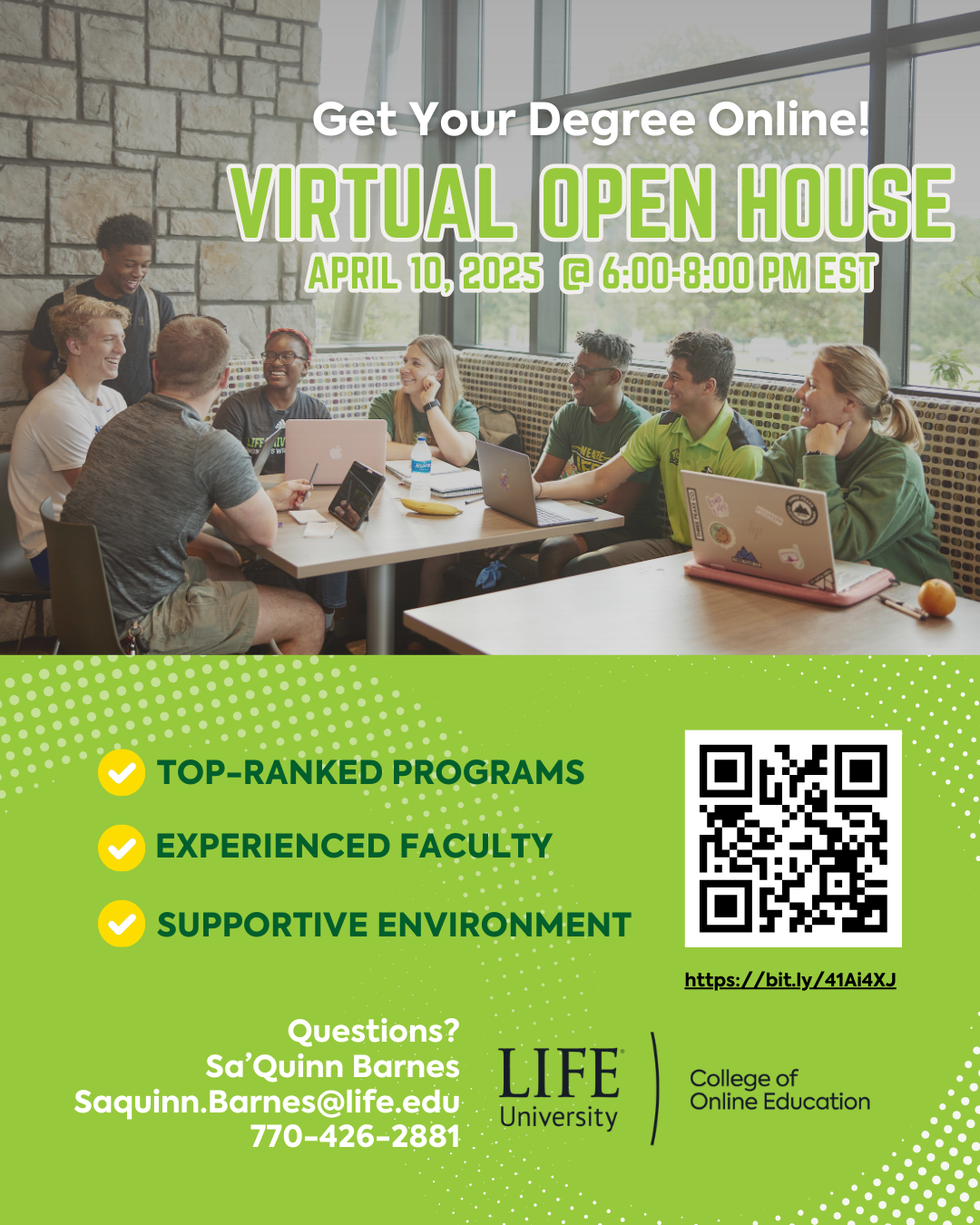
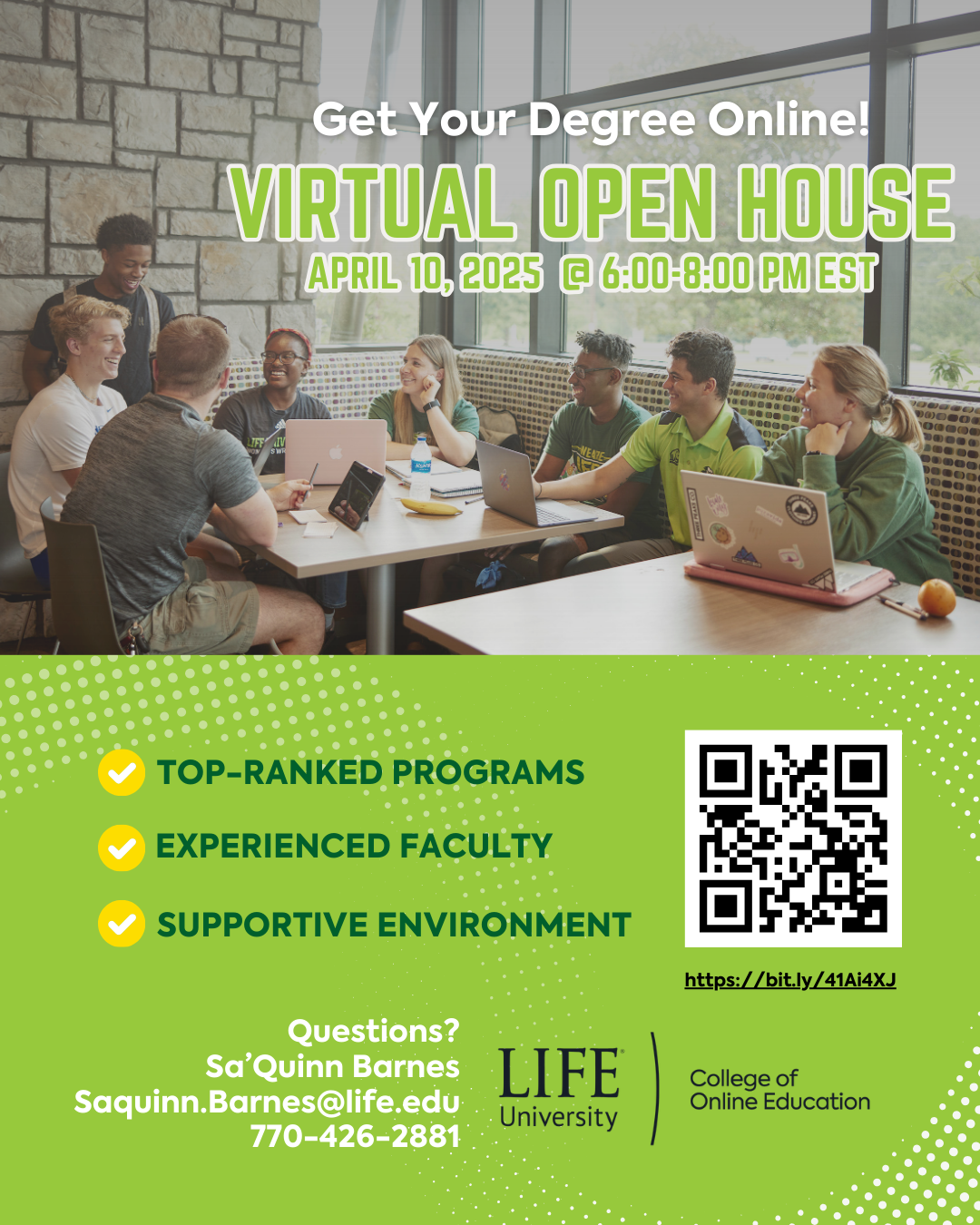
Life U is currently in the process of adding several more exciting undergraduate and graduate-level online degree programs, so stay tuned. Dr. Jo Lobertini, Associate Dean of COE, had much to say about online education at Life U.

“What sets online learning at Life U apart from the rest? Superior student support and course design. Online students receive superior support from institutional staff and faculty. Tutoring is available from within the online classroom, and there is a dedicated online advising liaison who works to make sure online advising needs are met. Faculty have years of experience teaching online and take part in COE-specific training when they are hired.

Two of the COE’s online programs, the B.S. in Biology and the M.S. in Positive Psychology, have won national awards for their program design and delivery. All COE courses are carefully designed and developed by a team made up of a subject matter expert (faculty member), an instructional designer and a media producer working under academic leadership oversight. In this process, the faculty contributes subject matter, and the instructional designer supplies course development guidance based on the Quality Matters (QM) higher education standards for quality in online course design. These standards have been examined for consistency with the conclusions of the educational research literature on factors that improve student learning and retention rates, as well as activities that increase learning and engagement,” said Dr. Lobertini.

M.S. in Positive Psychology (MSPP)- Two Tracks 

Life U offers the MSPP with two tracks: General Positive Psychology and Coaching Psychology. The MSPP is a fully accredited, one-of-a-kind online degree program. In fact, it is one of only a handful of such highly sought-after programs in the world. The MSPP at Life U investigates strengths-based research that enable individuals and communities to thrive.

B.S. in Biology

Life U’s Bachelor of Science in Biology curriculum is grounded in a philosophy that is deeply respectful of the innate intelligence of life – the ability of all organisms to be conscious, self-developing, self-maintaining and self-healing. Life U works closely with biology students to help them pursue their interests in advanced educational endeavors or STEM career pathways.

B.S. in Interdisciplinary Studies 

Life U’s Bachelor of Science in Interdisciplinary Studies provides a breadth of knowledge that is particularly advantageous in an increasingly complex and rapidly changing world, where today’s skills are quickly outdated by tomorrow’s new technologies. This degree equips students with the communication expertise, critical thinking abilities and a worldview that translate into transferable skills valued by all employers. 

B.S. in Psychology 

Life U’s Bachelor of Science in Psychology majors are taught to emphasize the inborn human capacities for love, courage, forgiveness, wisdom and interpersonal connection. Along with scientific study, these principles are woven throughout all coursework and culminate in real-life applications through either an internship or a senior thesis experience.

A.S. in Health and Wellness

Life University’s Health and Wellness associate degree program is designed for individuals who wish to take part in America’s cultural change toward sustainable health choices, fitness and wellness-centered lifestyles. Upon completion of this health science degree’s requirements, graduates will be prepared to seek employment with recreational and health club facilities; community or corporate wellness programs; or pursue independent contracting. Alternatively, they may choose to pursue further higher education study.

Learning to navigate the complexities of the human body while exploring how the body works and affects our physiology are just a couple of the fascinating areas that will be covered when students study for a Bachelor of Science in Anatomy and Physiology at Life University.
Explore the complex interdependencies between mind and body and using your knowledge to improve individual and group function. The interdisciplinary coursework will explore and challenge our collective knowledge of fundamental biopsychological concepts regarding bases of behavior, emotion and cognition and their relationship to health.
Blending good corporate citizenship with ethical business practice is the challenge facing businesses today. Corporate social responsibility and social entrepreneurship are not treated as just the latest buzzwords, but these business concepts provide a foundation for students to harness their power to manage successful economic, social and environmental relationships. A BBA student will practice and engage with various viewpoints of stakeholders to better understand how these relationships are likely to have a powerful impact on an organization’s long-term success and sustainability.
Students who pursue a degree in Computer Information Systems and Technology will learn the skills needed to make a positive impact on society and businesses utilizing information systems management.

Pre-Doctor of Chiropractic Pathway

This is a pathway designed to prepare students to go on to a Doctor of Chiropractic (D.C) program. There are three paths in which students can choose to complete this pathway. In the popular Path 1, students can earn their bachelor’s degree and work on their D.C program concurrently. In the Path 1 program, students have six potential majors to choose from, two of which are offered online (B.S. in Biology and B.S. in Psychology).


Slice of LIFE is an invitation to and extension of everything happening at Life University. Whether you are a current student, a potential freshman or a proud alum, Slice of LIFE can help keep you connected to your academic community. Know of a compelling Life U story to be shared, such as a riveting project, innovative group or something similar? Let us know by emailing Marketing@life.edu.

Campus Dietetics in Action with Cathy Tillery – Podcast

[vc_video link=”https://www.youtube.com/watch?v=-cGc2cnO-mQ” align=”center”][vc_separator]Figuring out the best ways to help Life University students and student athletes learn how to eat well is a full time job. Campus Dietitian Cathy Tillery explains the challenges that many students in the Life U community face as many of them are learning for the first time how to manage their own dietary needs.

Celebrating Graduate and Undergraduate Programs with Brandi Sharp – Podcast

[vc_video link=”https://www.youtube.com/watch?v=VBXnXYPLKlc” align=”center”][vc_separator]Brandi Sharp, Admissions Counselor and B.S. in Biopsychology student, spreads Lasting Purpose and the mission of Life University’s vitalistic philosophy to high school students looking for their next steps. Sharp discusses the joy of that process and what keeps her going.