arrow-down arrow-left arrow-nav arrow-right arrow-up close db-alumni db-current db-faculty db-fmaily db-future db-online download facebook gallery help linked-in maximize menu minimize pause play print search share twitter youtube zinfolio

Life U & ICF Georgia Present: M.S. in Positive Psychology Day of CCE & Networking

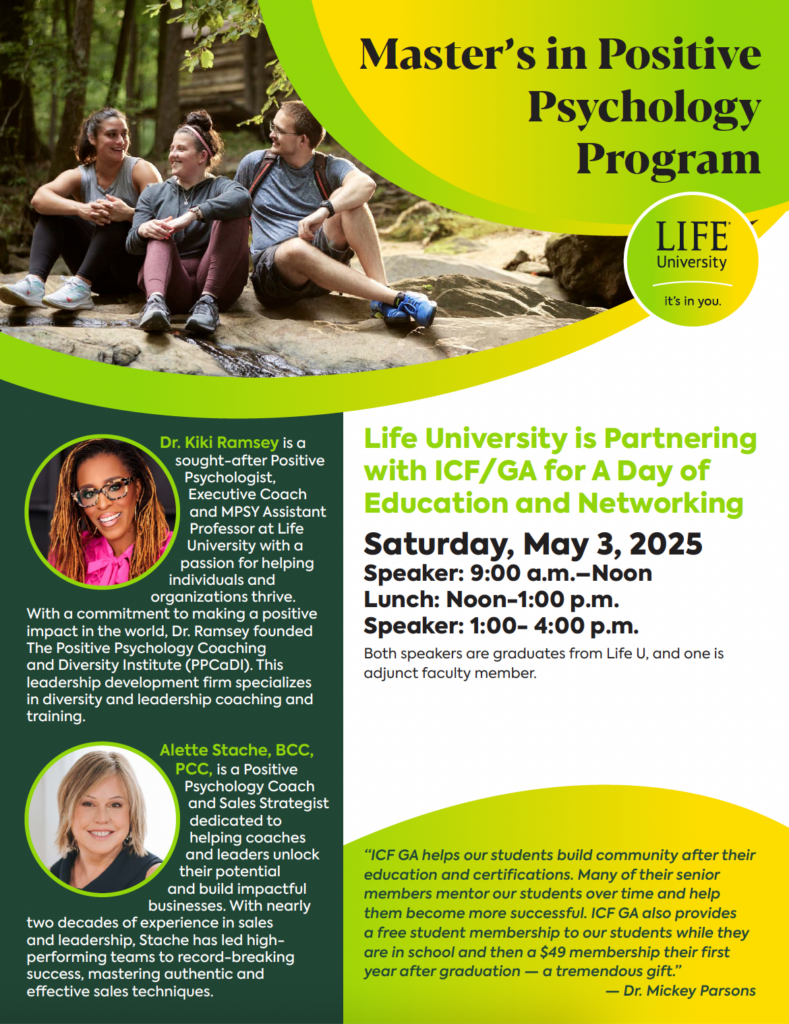
Life University & ICF Georgia Present: Master’s in Positive Psychology Day of Continuing Coaching Education & Networking

Join Life University and the International Coaching Federation Georgia (ICF/GA) for an inspiring day of education, networking and professional growth!

Screen shot 2025 03 31 at 3.44.53 pm

Date: Saturday, May 3, 2025
Location: Life University, Marietta, Georgia
CE Credits: Earn up to 6 CCE credits.
Hosted by: Life University & ICF/GA

This engaging event, part of Life U’s Spring Residency, offers a unique opportunity to deepen your understanding of Positive Psychology while connecting with like-minded professionals.

What to Expect:

  • Expert Speakers – Learn from Life U graduates Dr. Kiki Ramsey, a sought-after Positive Psychologist and Executive Coach, and Alette Stache, an experienced Positive Psychology Coach and Sales Strategist. They will share practical applications and research-backed strategies to enhance your practice.
  • Networking & Community – Engage with peers, mentors, and industry leaders to build lasting professional relationships.
  • Interactive Learning – Gain insights into the latest advancements in Positive Psychology and coaching techniques.
  • Lunch Break – Enjoy a meal while fostering connections in a collaborative setting.

Don’t miss this great opportunity to learn, grow and earn CCE credits in a supportive and dynamic environment.

🔗 Register Now

Business Ideas with Low Overhead for College Students

A fair number of our enterprising Business Administration students at Life University (Life U) are more than eager to hit the ground running and start managing exciting businesses of every flavor and color under the rising sun. However, there is something to be said for starting small, applying honed skills in a real-world setting and then working to leverage modest gains into larger dreams.

It’s central and necessary for business-minded students to find practical ways to apply their developing knowledge while in school, whether that is through internships at established businesses or striking out on a personal venture.

Idea 1: Coaching

Coaching of various kinds lends itself well to a college student’s strengths and scheduling needs. It does require some networking and getting to know potential clients. The first step would be identifying what value proposition you can offer as a coach, whether in a professional setting or through a specialized niche market. Goal setting and creating actionable plans and strategies to help your clients achieve their desired outcomes is the name of the game. Here are some categories of coaching that can become solid businesses:

  • Sports or fitness coaching. For the many athletically skilled, active and passionate student-athletes at Life U, it would be a pleasure and honor to foster the personal growth of others in sports and fitness.
  • Career, professional and/or leadership coaching is another pathway to explore, though it may require more study or work experience to establish credibility. For those interested in honing their coaching skills in this area, Life U offers a Master of Science in Positive Psychology (M.S.P.P.) – Coaching Psychology track that prepares students for a career in this field.

Idea 2: Design

A creative mind is a shame to waste. If you love making visually pleasing content or products, lean into that. A design-forward business can take many forms, such as:

  • Web design services for individuals and businesses
  • Graphic design in the form of logos, website graphics, flyers and countless other design needs
  • Clothing and fashion design, especially if the approach is innovative and/or philanthropic in some manner, as consumers are beginning to think more critically about the impact of their clothing choices. Sustainably focused brands, for example, are popular, but be critical in examining the tangible environmentally friendly nature of your process rather than simply greenwashing (i.e., making products that appear on the surface to be green to assuage the public guilt, but in actuality are not).
  • Interior design. If you have a proven track record for how to transform spaces in an aesthetically pleasing manner, you can leverage that into an effective business.

Depending on the design business type, there might be certain software or inventory requirements involved. In regard to software, there may be some resources available to you through Life U’s Drs. Sid E. & Nell K. Williams Library while you are a student.

Idea 3: Service

Commitment to hard work and fair customer service can get you far as a business owner. Many entrepreneurs start out by operating and working part-time in basic, personal or home services kind of business, such as:

  • Cleaning services in homes, offices and other locations
  • Delivery services
  • Nannying or babysitting
  • Cooking, baking or personal chef services
  • Handyman services or ‘odd jobs’ for basic home maintenance not requiring extensive training
  • Cosmetology for hair styling and nail care, though professional certifications will likely be required for more advanced services, such as haircuts or hair coloring as a business.
  • Landscaping and yard care

Idea 4: Social Media Marketing and Management

Having a responsive social media presence is a huge part of gaining brand awareness for businesses of any size. If you naturally understand how to encourage engagement with your personal social media channels, that skill set is easily translatable to developing a social media management business, where you manage social media pages for a business or several businesses.

Idea 5: Digital Content Creation

If you are a voracious reader and have a flair with words, content creation and marketing could be a good path for you. Many businesses will pay well for targeted blogs, articles, copywriting, e-books and more.

Idea 6: Editing and Proofreading

If you have ever been accused of working for the Grammar Police, editing and proofreading could flourish into a viable business identity. It could start by editing the papers, reports, résumés and cover letters of fellow college students. Then, with a proven track record, you can expand that to editing articles and other written content in a professional setting.

Idea 7: Online Sales and Ecommerce

Curated online shops and pages are gaining steam. If you can offer a unique product, a product that fits a certain niche and/or deliver products in a convenient way, a loyal customer base can be built on that foundation. Item resale, drop shipping or creating and selling handmade items are some common examples that can be run out of small spaces.

Advice from a Beloved Life U Professor

Professor Marie Powell is a respected member of our Business Department with so many pearls of wisdom to share with our entrepreneurial students. Here are just a few with which we will close.

  • Be prepared to build discipline into your plan of action. This means scheduling time to get tasks done that will help you create positive outcomes for your business.
  • Create a one-pager business plan. Set your goals in a written format. It becomes a guideline that should be flexible and allows you to pivot and adjust along the way as you build your business brand.
  • Find a business that you have passion for. Boring products and services you care nothing about will die quickly and you will find yourself chasing a business and wasting time.
  • Be prepared to be to tell your story. In social media, storytelling wins over customers better than a boring, traditional advertisement. Market your product or service in this most inexpensive way.
  • Don’t be selling. Engage, create connection with your customer and approach with a human side. Be sure you understand the customer you are targeting. Be humble and caring.
  • Do research on your product or service industry. Discover what your competitors are lacking and find the sweet spot of connection to tell your customer why your product or service will give them what they want and need.
  • Let your customers tell you what they want. Listen, listen, listen. Build your business with your customer in mind, not what you think they want.
  • Keep up with how your business is doing financially. Keep track of your spending and buying.

References

https://www.indeed.com/career-advice/finding-a-job/ideas-for-business-for-students

Reconfiguring the collegiate landscape, looking at how to better welcome ‘non-traditional’ students

One delightful aspect of the Life University (Life U) student body makeup is the fact that we support students from all different walks of life. For example, as recorded in the Fall 2022 Annual University Fact Book, 67 percent of Life U students are pursuing a Chiropractic or Graduate level degree. With such a large portion of the Life U campus past the undergraduate stage of their education, it’s necessary that the University take stock and figure out how best to serve a growing ‘non-traditional’ student population.


What are ‘non-traditional’ students?

The National Center for Education Statistics has debated what constitutes a traditional versus non-traditional student, as the norms for when, where and how students choose to continue their education has been much in flux in recent years. However, age plays a big part in this puzzle, as the older the student is, the more likely they are juggling other major responsibilities, such as work, children and mortgages. Here at Life U, the Fall 2022 Fact Book listed 41 percent of undergraduate students as over age 22. So, we understand there are many competing demands for your time and energy, and we want to make your educational experience as successful as possible.


Flexibility for your life at Life U

Make your education work for you by selecting a learning style that works for your life. Life U has been working tirelessly to give students more options to meet their class requirements. In the 2021 Fall Quarter, LIFE Flex was unveiled. It is an innovative approach to course delivery that provides students with flexibility and multiple learning opportunities.

Students had the ability for the first time to choose to engage with classes in three different learning styles: face-to-face experience on-campus; synchronously (real-time) online; or in some cases, in a self-guided, asynchronous (not real-time) option for portions of courses. Online offerings are accessed via Blackboard, Life U’s learning management system. Effective for the 2021 Fall Quarter, all Life University lecture classes utilized the LIFE Flex format. For a fuller picture of LIFE Flex, please read our full article on the topic titled “What’s Your Life (U) Style? – LIFE Flex Overview.”


Online degree programs offered at Life U for added convenience

Life U is currently in the process of adding several more exciting undergraduate and graduate-level online degree programs, so stay tuned. Dr. Jo Lobertini, Associate Dean of COE, had much to say about online education at Life U.

“What sets online learning at Life U apart from the rest? Superior student support and course design. Online students receive superior support from institutional staff and faculty. Tutoring is available from within the online classroom, and there is a dedicated online advising liaison who works to make sure online advising needs are met. Faculty have years of experience teaching online and take part in COE-specific training when they are hired.

Two of the COE’s online programs, the B.S. in Biology and the M.S. in Positive Psychology, have won national awards for their program design and delivery. All COE courses are carefully designed and developed by a team made up of a subject matter expert (faculty member), an instructional designer and a media producer working under academic leadership oversight. In this process, the faculty contributes subject matter, and the instructional designer supplies course development guidance based on the Quality Matters (QM) higher education standards for quality in online course design. These standards have been examined for consistency with the conclusions of the educational research literature on factors that improve student learning and retention rates, as well as activities that increase learning and engagement,” said Dr. Lobertini.

M.S. in Positive Psychology (MSPP)- Two Tracks 

Life U offers the MSPP with two tracks: General Positive Psychology and Coaching Psychology. The MSPP is a fully accredited, one-of-a-kind online degree program. In fact, it is one of only a handful of such highly sought-after programs in the world. The MSPP at Life U investigates strengths-based research that enable individuals and communities to thrive.

B.S. in Biology

Life U’s Bachelor of Science in Biology curriculum is grounded in a philosophy that is deeply respectful of the innate intelligence of life – the ability of all organisms to be conscious, self-developing, self-maintaining and self-healing. Life U works closely with biology students to help them pursue their interests in advanced educational endeavors or STEM career pathways.

B.S. in Interdisciplinary Studies 

Life U’s Bachelor of Science in Interdisciplinary Studies provides a breadth of knowledge that is particularly advantageous in an increasingly complex and rapidly changing world, where today’s skills are quickly outdated by tomorrow’s new technologies. This degree equips students with the communication expertise, critical thinking abilities and a worldview that translate into transferable skills valued by all employers. 

B.S. in Psychology 

Life U’s Bachelor of Science in Psychology majors are taught to emphasize the inborn human capacities for love, courage, forgiveness, wisdom and interpersonal connection. Along with scientific study, these principles are woven throughout all coursework and culminate in real-life applications through either an internship or a senior thesis experience.

A.S. in Health and Wellness

Life University’s Health and Wellness associate degree program is designed for individuals who wish to take part in America’s cultural change toward sustainable health choices, fitness and wellness-centered lifestyles. Upon completion of this health science degree’s requirements, graduates will be prepared to seek employment with recreational and health club facilities; community or corporate wellness programs; or pursue independent contracting. Alternatively, they may choose to pursue further higher education study.

Learning to navigate the complexities of the human body while exploring how the body works and affects our physiology are just a couple of the fascinating areas that will be covered when students study for a Bachelor of Science in Anatomy and Physiology at Life University.
Explore the complex interdependencies between mind and body and using your knowledge to improve individual and group function. The interdisciplinary coursework will explore and challenge our collective knowledge of fundamental biopsychological concepts regarding bases of behavior, emotion and cognition and their relationship to health.
Blending good corporate citizenship with ethical business practice is the challenge facing businesses today. Corporate social responsibility and social entrepreneurship are not treated as just the latest buzzwords, but these business concepts provide a foundation for students to harness their power to manage successful economic, social and environmental relationships. A BBA student will practice and engage with various viewpoints of stakeholders to better understand how these relationships are likely to have a powerful impact on an organization’s long-term success and sustainability.
Students who pursue a degree in Computer Information Systems and Technology will learn the skills needed to make a positive impact on society and businesses utilizing information systems management.

Pre-Doctor of Chiropractic Pathway

This is a pathway designed to prepare students to go on to a Doctor of Chiropractic (D.C) program. There are three paths in which students can choose to complete this pathway. In the popular Path 1, students can earn their bachelor’s degree and work on their D.C program concurrently. In the Path 1 program, students have six potential majors to choose from, two of which are offered online (B.S. in Biology and B.S. in Psychology).


Slice of LIFE is an invitation to and extension of everything happening at Life University. Whether you are a current student, a potential freshman or a proud alum, Slice of LIFE can help keep you connected to your academic community. Know of a compelling Life U story to be shared, such as a riveting project, innovative group or something similar? Let us know by emailing Marketing@life.edu.

Considering a Master’s Degree? Reasons to Think About a Higher-Level Degree

Advanced education can be an asset that opens doors to exciting career paths and increased income, yet it requires a significant commitment of time and resources. If you are on the fence about pursuing a master’s degree, then it is time to dig a little deeper to see if graduate study is right for you.

The U.S. Bureau of Labor Statistics published a handy guide titled “Should I get a master’s degree?” that examines the benefits and possible challenges related to the question. In short, part of the decision-making process if a master’s degree is your next wise step relies on the kind of career path in which you are engaged or interested. There are of course some occupations in which a master’s degree is a prerequisite for even entry-level positions. These include therapists, many jobs in a traditional medical environment, social workers and more. So that is consideration number one, to see if a master’s degree is required to meet your career goals.

Alternatively, if a master’s degree is not necessarily a requirement in your chosen field, it may still prove beneficial to you in terms of enhanced skill sets and better earnings. In general, there are several professional fields that workers commonly earn more with a master’s degree as opposed to a bachelor’s degree alone. These include business, education, STEM, health care and social service.

Questions to Ask Yourself When Thinking About a Master’s Degree

Choosing whether or not to pursue a master’s degree is a personal decision and not one to be taken lightly. Take the time to answer some vital questions before moving forward.

  • Why do I want a master’s degree?

It is essential to understand what your expectations are, so you won’t be disappointed later on. Some programs, for example, are more academically focused, where the main purpose is to study a subject in greater detail. Others are more geared toward preparation for your career in a specified occupation. So, you need to know upfront what you are hoping to get out of it and if a particular program meets those needs.

  • Who can I talk to so that I can learn more?

Career resources are helpful, but insider information from others in the field and at the level that you hope to achieve can prove indispensable. Talk to people currently working in your specific field of interest about what employers are looking for so that you can find a master’s degree that matches. Tap into your network to find people, such as through your undergraduate school’s alumni career center.

  • What are relevant job postings asking for?

If in your job search you find that most of the jobs you are interested in are asking for or requiring a master’s degree, that might be a good indicator of what you need to do.

  • What will it all cost?

There are financial pros and cons to consider in this process. In addition to tuition, you will have to put money toward books and other educational expenses. Not to mention, a master’s degree takes on average two years to complete and will take available time away that could be used to earn in the workforce. Loans and financial aidcan be of major assistance, but it is important to go into a program with your eyes open.

  • Do I have other options?

Professional programs, certifications and an excellent track record of work experience are other valuable tools in the job market in addition to a master’s degree. 

Master’s Degree Programs Offered at Life University

If a master’s degree is the right next step for you, Life University (Life U) offers a range of comprehensive master’s degree programs to help you maximize your innate potential.

 In the Department of Sport Health Science at Life University, our Master of Science in Sport Health Science degree program explores numerous aspects of optimal human performance, from the elite athlete to members of the community improving their fitness.

Life U’s unparalleled master’s program in Sport Health Science is designed to advance your undergraduate and professional knowledge, experience and passion for human athletic performance. With extensive, hands-on labs, practicums and internships available both on and off campus, you won’t have to wait until after graduation to get in the game.

The M.S. Sport Health Science degree is a 52-credit hour program (approximately four quarters long). This master’s degree includes specialty tracks in the professional fields of Exercise and Sport Science; Sport Injury Management; Sport Coaching; Nutrition and Sport Science; Chiropractic Sport Science; and Tennis Fitness and Sport Science. The curriculum is designed to permit graduates with an interest in these specific sport health science concentrations to realize their personal and professional goals.

A growing understanding of the health impact of sound nutrition, along with concerns about an aging population, food safety and a rise in nutrition-related disorders, is fueling demand for nutrition experts. Life U’s Master of Science in Clinical Nutrition provides you with just such an education to fulfill this demand.

Clinical nutritionists need to understand and interpret the implications of clinical research, use such research in evidence-based practice, and collect and analyze data. Contemporary dietetics professionals must also possess a strong understanding of “nutrigenomics,” the study of the effects of food on gene expression and an understanding of the biological activity of food components.

Life U offers the MSPP with two tracks: General Positive Psychology and Coaching Psychology. The MSPP is a fully accredited, one-of-a-kind online degree program. In fact, it is one of only a handful of such highly sought-after programs in the entire world. The MSPP at Life U investigates strengths-based research that enables individuals and communities to thrive. It is focused on the study of flourishing and positive human functioning, in particular within key areas such as meaning in life and cultivating gratitude, compassion and forgiveness.

Life U is constantly working to provide new and innovative programs for students, so please visit the College of Graduate and Undergraduate Studies homepage to see updates to offerings.


Slice of LIFE is an invitation to and extension of everything happening at Life U. Whether you are a current student, a potential freshman or a proud alumni, Slice of LIFE can help keep you connected to your academic community. Know of a compelling Life U story to be shared, such as a riveting project, innovative group or something similar? Let us know by emailing Marketing@life.edu.

Positivity and Impact from the M.S in Positive Psychology program, with Alette Stache and Alison Smith-Podcast

[vc_video link=”https://www.youtube.com/watch?v=k4aTHWncP8Q” align=”center”][vc_separator]Follow two accomplished Life University M.S in Positive Psychology students, Alette Stache and Alison Smith, as they ruminate on how this one-of-a-kind online program has helped them to grow personally. As they both approach graduation rapidly, it is a time of reflection and gratitude.

Training the Trainer, Chronic Obstructive Pulmonary Disease (COPD) Coaching- Research Series

Dr. Maria Benzo, Master’s in Positive Psychology (Graduated in Fall 2022); Advisors: Dr. Richard E. Shook, Assistant Professor, Psychology, CGUS and Dr. Peggy Samples, Assistant Professor of Psychology, COE

“Training the Trainer, Chronic Obstructive Pulmonary Disease (COPD) Coaching”


Dr. Maria Benzo’s research project involves creating an online training program for health coaches to help their Chronic Obstructive Pulmonary Disease (COPD) patients cope with their disease, using positive psychology techniques. Benzo’s area of expertise is COPD, and she is a medical doctor at the Mayo Clinic as a Research Associate in the Pulmonary Research Department. Benzo does health coaching for COPD and has a background in mindfulness and motivational approaches to therapy. As a trainer of health coaches, her goal is to create content for health coaches to help their clients manage their responses to the effects of COPD.

“Everything we do from the lab is to empower patients, motivate patients and facilitate self- management,” Benzo said. “I personally fell in love with positive psychology, so that is why I am bringing the science of positive psychology to what we do in the lab.”

Benzo’s first step in this research project was to find as much published information as possible regarding this topic. From that research, Benzo wrote the Capstone using the appropriate information to apply it in health care coaching for patients who suffer from COPD, which causes breathlessness. Patients who are breathless seek independence and struggle to cope with their chronic condition.

After finding and selecting the right content to use in her online training, the next step was to find a free online platform. Benzo then created a series of videos for health coaches. She then asked health coaches to sign up for her online program and watch her educational videos and take the quizzes she created that went along with the videos, allowing them to thoroughly review her content.

From this, Benzo received great feedback through two focus groups she hosted live online. Health coaches helped her improve her videos with such suggestions as creating stronger web design and putting herself on screen for longer periods to allow the health coaches to connect with her and what Benzo was sharing. The health coaches wanted to feel as though they had someone who was going through the program with them. Another key response Benzo received was that her PowerPoint slides needed consistency with the same theme throughout, allowing the learner to ease their way through the program.

From this research, Benzo will “create this online training and have it available to all Life University students interested in applied positive psychology to access and go through the training.” Her research hypothesis is the following: Are health coaches able to gain the knowledge and confidence through this training to apply positive psychology in their health coaching sessions with COPD patients? Secondly, do patients with COPD benefit from applied psychology health coaching?

Dr. Benzo completed her research and graduated in December 2022.


This article was originally published in Your Extraordinary Life (YEL), Life University‘s Alumni and Friends Magazine, 2022- Volume 15. YEL started in 2009 as a twice-per-year publication before moving to three issues per year from 2010-2017. In 2018, University leadership made the decision to publish a larger, more elegant version of the magazine just once per year that our alumni and friends could be proud of. YEL features an in-depth look at all things Life University, from alumni and student human interest stories to recaps and previews of the University’s biggest events. If you are a proud Life University alumni, friend or supporter, this publication is one you can’t miss!

Read the latest issue and past issues at this link or pick up a print copy on campus.